Why Your Neck Hurts After Work (And 3 Stretches That Help)
You sit down at your desk at 9 AM. By 11, your neck feels tight. By 2 PM, there's a dull ache. By 5, you're rotating your head trying to release the tension.
If this sounds familiar, you're not alone. Neck pain is one of the most common complaints among desk workers, and it's not random. There's a specific reason your neck hurts, and specific movements that may help.
Why Desk Work Causes Neck Pain
The culprit is called forward head posture.
When you look at a screen, your head naturally drifts forward. Your chin juts out. Your shoulders round. This position puts significant strain on your neck muscles.
Here's why: your head weighs about 10-12 pounds. When it's properly aligned over your spine, your neck muscles don't have to work hard to support it. But for every inch your head moves forward, the effective weight on your neck muscles increases dramatically.
When your head is forward:
- Your neck muscles have to constantly contract to hold your head up
- The muscles at the base of your skull get overworked
- Your upper trapezius (the muscle between your neck and shoulder) stays tense
- The natural curve in your neck flattens or reverses
Do this for hours every day, and those muscles get tired, tight, and painful.
The solution isn't just "sit up straight" (though that helps). It's actively stretching the tight muscles and strengthening the weak ones.
3 Stretches That May Help Relieve Desk Neck Pain
These stretches are designed to counteract forward head posture. They take under 5 minutes total. No equipment needed.
Stretch 1: Chin Tucks
What it does: Helps retrain your neck to hold a neutral position and may strengthen the deep neck flexor muscles.
How to do it:
- Sit up straight with your shoulders relaxed and down
- Keep your eyes looking straight ahead (don't tilt your head)
- Gently draw your chin straight back, as if you're making a double chin
- You should feel the back of your neck lengthen
- Hold this position for 5 seconds
- Return to your starting position
- Repeat 10 times
Key tip: Don't tilt your head down or up. Keep it level while pulling your chin back. Think of your head gliding backward on a horizontal track.
When to do it: Every 1-2 hours during your workday. This is quick enough to do between tasks.
Stretch 2: Side Neck Stretch
What it does: Designed to help release tension in the upper trapezius and side neck muscles (scalenes).
How to do it:
- Sit upright in your chair with both feet flat on the floor
- Place your right hand gently on the left side of your head (above your left ear)
- Slowly and gently pull your head toward your right shoulder
- Keep your left shoulder down and relaxed (don't let it hike up)
- Hold for 15-20 seconds
- You should feel a gentle stretch along the left side of your neck
- Return your head to center
- Repeat on the other side
Key tip: This should feel like a gentle stretch, not pain. If it hurts, ease off. The weight of your hand should be enough. Don't pull aggressively.
When to do it: Mid-morning and mid-afternoon, or whenever you notice one side of your neck feeling particularly tight.
Stretch 3: Upper Trapezius Stretch
What it does: May help relieve the tightness and knots in the muscle that runs from your neck to your shoulder.
How to do it:
- Sit up straight
- Tilt your head to bring your right ear toward your right shoulder
- Reach your right hand over your head and gently rest it on the left side of your head
- Apply very light pressure (the weight of your arm is usually enough)
- For an increased stretch, reach your left arm down and slightly behind you
- Hold for 20-30 seconds
- You should feel a stretch from your left shoulder up into your neck
- Return to center
- Repeat on the other side
Key tip: Don't rotate your head, just tilt it sideways. Keep your shoulders down and relaxed throughout.
When to do it: This is especially helpful at the end of the workday when tension has built up.
When to Do These Stretches
Ideal timing:
- Morning: After you've been at your desk for about an hour (Chin Tucks)
- Midday: Around lunch or mid-afternoon when tension peaks (all three)
- End of day: Before you leave your desk (Side Neck Stretch and Upper Trap Stretch)
Frequency: Aim to do at least one set of these stretches every 90 minutes during your workday. The more frequently you interrupt the forward head position, the better.
Consistency matters more than intensity. Brief, frequent stretching beats one long session at the end of the day.
What If the Pain Persists?
These stretches are designed to help with typical desk-related neck tension. But if you experience:
- Sharp, shooting pain
- Pain that radiates down your arm
- Numbness or tingling in your hands
- Pain that doesn't improve with stretching
You should consult a healthcare professional. These could be signs of a more significant issue like a herniated disc or nerve compression.
Automate Your Neck Care
The exercises work, but only if you remember to do them.
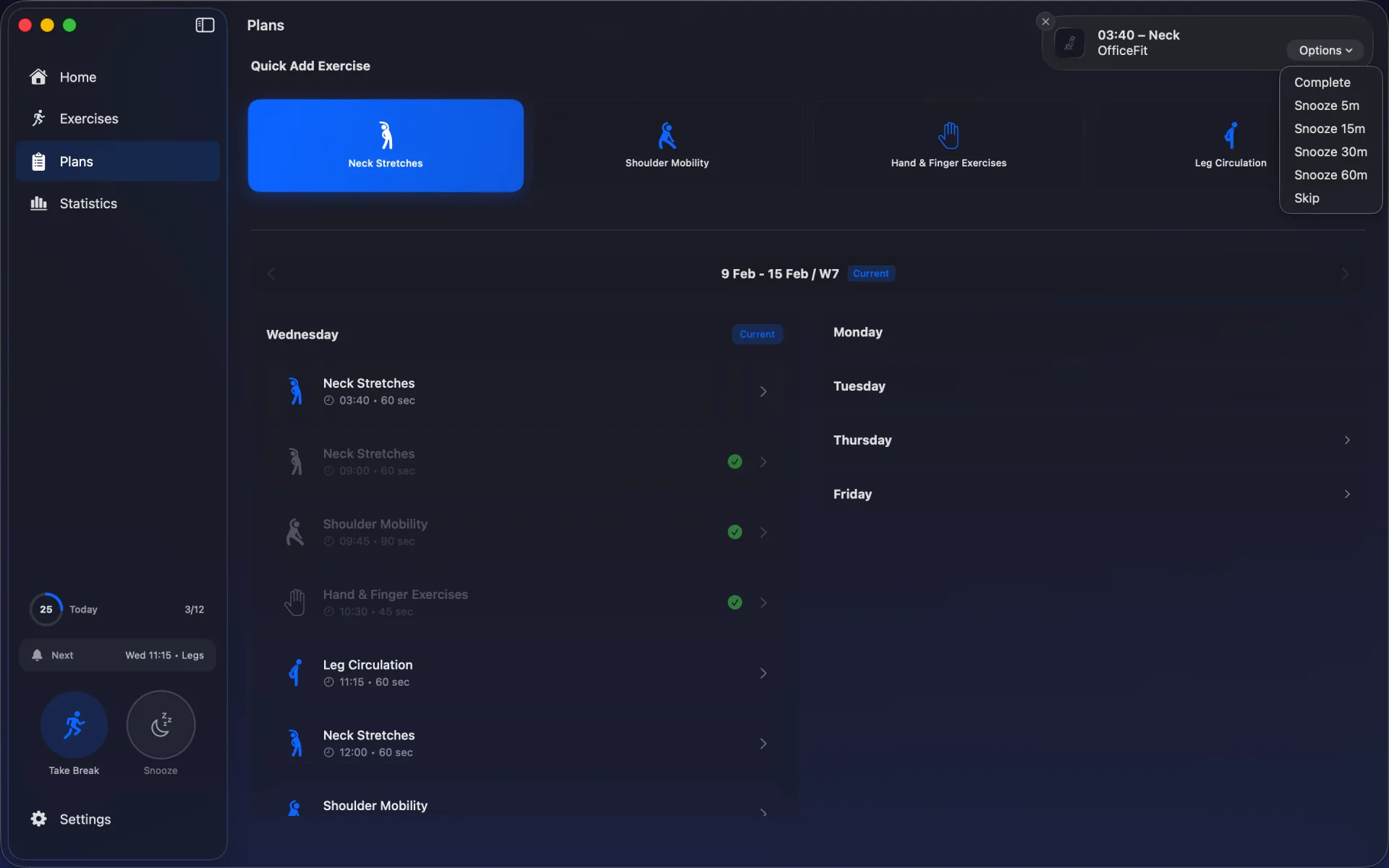
If you're tired of relying on willpower alone, OfficeFit is a macOS app built specifically for desk workers. It sends gentle reminders based on your actual work schedule, guides you through exercises like these with step-by-step instructions, and tracks your consistency over time.
It supports any work schedule, including night shifts and irregular hours. The app includes guided exercises for your neck, shoulders, hands, and legs.
Join the beta waitlist to get launch updates and early access: Join OfficeFit Beta
Your neck doesn't have to hurt every day. Start with these three stretches. Make them a habit. Your future self will thank you.
For more desk exercises beyond just your neck, check out our complete desk exercise guide.
Build this habit with OfficeFit
Turn these exercises into a daily routine with reminders and guided sessions.
Read Next
RSI Prevention for Mac Users: Protecting Your Hands and Wrists
If you use a Mac for work (whether you're a developer, designer, writer, or knowledge worker), your hands and wrists are constantly in motion. Typing, clicking, swiping on the t...
The Complete Desk Exercise Guide for Office Workers
If you work at a desk, you already know the feeling. Your neck gets stiff after a couple of hours. Your shoulders start aching by midday. Your wrists hurt from typing. Your legs...